
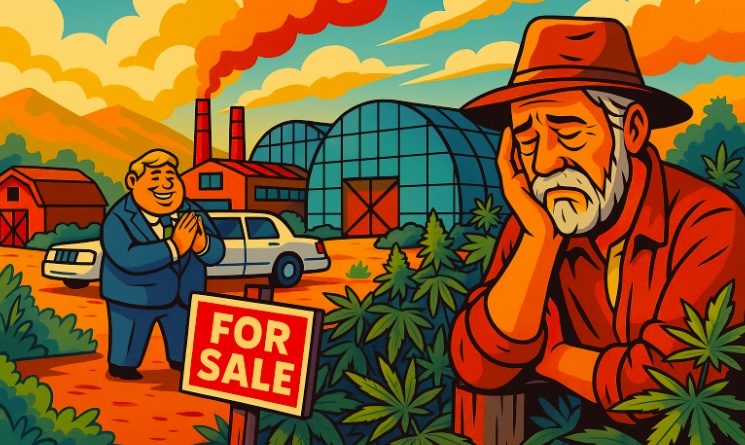
How Corporate Greed and Broken Promises Destroyed Small Farmers in California
The legalization of cannabis in California was sold as a revolution—one that would protect small farmers, empower local economies, and bring the legacy growers of the Emerald Triangle into a thriving new era. Instead, it has become a cautionary tale of broken promises, blatant corporate favoritism, and devastating overregulation. The so-called “green rush” has left countless small farms in ruins while massive corporations flourish, all under the guise of progress.
California’s Cannabis Crisis in Focus
- California’s small farms are being crushed by mega-growers enabled by overregulation and corporate favoritism.
- The removal of the 1-acre farm cap paved the way for industrial-scale cultivation, driving wholesale prices to unsustainable lows.
- Overregulation and middlemen distributors make it nearly impossible for small farms to profit.
- Direct-to-consumer sales could save small farms, but the state vetoed the bill allowing it.
- Rural communities and generational cannabis businesses are collapsing under the current system.
- Supporting small farms preserves cannabis culture, sustainability, and legacy strains.
The False Promise of Protecting Small Farmers

In 2015, then-Lieutenant Governor Gavin Newsom stood before an audience of cannabis growers in Humboldt County, assuring them that corporate interests would not take over California’s cannabis market. His message was clear: the state would stand by its small family farms. Yet, as legalization unfolded, this promise unraveled faster than a poorly rolled joint.
Proposition 64 was supposed to keep farms small and community-driven, capping cultivation at 1 acre for the first five years. Then came November 2017, when that promise disappeared like smoke in the wind. Regulatory authorities erased the cap, paving the way for mega-corporations to dominate. Was this a clerical oversight? Hardly. Large farming lobbies in regions like Santa Barbara swooped in, making sure their interests took precedence over Northern California’s legacy growers.
The results were as predictable as they were devastating. Mega farms began cultivating cannabis on a scale unimaginable to the small growers of Humboldt, Trinity, and Mendocino counties. The very same farmers who pioneered sustainable, craft cannabis practices were left scrambling to compete with million-square-foot corporate grow operations funded by hundred-million-dollar loans.
Protecting small farms? It’s hard to protect what you’re actively destroying.
The Mega Farms Takeover

The decision to lift the 1-acre cap wasn’t just a betrayal; it was the moment California’s cannabis market became a rigged game. As small farms struggled to navigate licensing hurdles and taxation nightmares, industrial-scale operations flooded the market with cheap, mass-produced cannabis. Wholesale prices plummeted from $2,000 per pound to as low as $100.
Yes, that’s right—$100.
That’s not a “market correction”; it’s economic obliteration for family farmers.
Consider Glass House Farms, one of the state’s largest cannabis producers. This industrial powerhouse operates out of a 2 million-square-foot facility, churning out over 230,000 pounds of cannabis in a single quarter. For perspective, that’s more than Humboldt County’s entire output in the same period. How are small farms supposed to compete?
Spoiler alert: they aren’t.
This isn’t capitalism. It’s legalized cartel behavior, enabled by regulatory capture. Instead of fostering competition, California handed the market to mega-growers on a silver platter. And as for the farmers who thought they’d finally have the right to thrive legally? They’ve been left holding the short end of the stick.
Why Small Farms Are Failing

It’s not just the scale of production that’s strangling small farms; it’s the layers of bureaucracy and red tape that make operating legally almost impossible. Getting licensed is expensive, navigating distribution laws is a nightmare, and taxes—well, they’re enough to make anyone nostalgic for the days of prohibition. Back then, at least farmers weren’t paying exorbitant fees to stay compliant with laws designed to drive them out of business.
Cannabis cultivators in California are prohibited from selling directly to consumers, unlike any other agricultural producer. Imagine a winery forbidden from running its own tasting room or a vegetable farmer banned from selling at a farmers market. Instead, small growers must go through distributors, who take their cut, and retailers, who take even more. By the time their product reaches the consumer, the farm sees pennies on the dollar.
This overregulation has created a system where only the largest operations can survive. Half of California’s licensed farms didn’t renew their licenses last year. That’s not a statistic; it’s a death sentence for the Emerald Triangle’s vibrant cannabis culture. It’s almost as if the state designed the system to fail—except, of course, for the corporations with the resources to game it.
Farmers Markets Could Be a Lifeline

Amid this bleak landscape, small farms have championed one lifeline: direct-to-consumer sales. The ability to sell cannabis at farmers markets could transform the industry, giving cultivators the chance to bypass middlemen and connect with consumers. Yet Governor Newsom vetoed a bill that would have allowed these sales, citing “government strain” as his excuse. Government strain? The only strain here is the one felt by the farmers being crushed under the weight of California’s corporate cannabis laws.
Farmers markets aren’t just a nice idea; they’re a proven model for supporting small businesses. When growers sell directly to consumers, they keep more of their profits, share their story, and differentiate their product from mass-produced cannabis. For small family farms, it’s not just about survival; it’s about reclaiming the soul of California’s cannabis industry.
The Human Toll of Corporate Cannabis

When California decided to roll out the red carpet for corporate cannabis, it didn’t just impact farms—it gutted communities. For decades, the Emerald Triangle wasn’t just a region; it was a culture, a legacy, and a way of life. Generational farmers who pioneered sustainable cultivation practices are now watching their family businesses collapse under the crushing weight of industrial competition and regulatory incompetence. Entire towns, once thriving on the back of small-scale cannabis farming, are now shadows of their former selves.
The economic fallout is severe. Rural areas dependent on small farms have seen a cascade of closures: local businesses shuttered, families uprooted, and property values plummeting. Imagine dedicating decades to a craft, only to be priced out of the very market you helped build. The Emerald Triangle isn’t just losing farms; it’s losing its identity, all while corporate conglomerates reap the benefits of a rigged system.
One can only marvel at the hypocrisy. The same state officials who sang the praises of craft cannabis now seem deaf to the pleas of farmers struggling to survive. It’s almost as if they planned it this way—consolidating the industry into the hands of a few mega-players while claiming they “stand with small farms.” If this is standing with them, one wonders what betrayal might look like.
What Needs to Change

If California is serious about saving its cannabis legacy, it needs to rewrite the rulebook—yesterday. The current regulatory framework is an overcomplicated mess designed to suffocate small operators while rolling out the green carpet for industrial-scale farms. Taxation alone is enough to make any reasonable farmer question why they bothered transitioning to the legal market.
Here’s what needs to happen:
- Fair taxation policies: Lower the exorbitant tax rates that punish small farmers. After all, cannabis once paid taxes—it shouldn’t bankrupt those who grow it.
- Direct-to-consumer sales: Allow farmers to bypass distributors and sell directly to their customers. This isn’t rocket science; it’s common sense.
- Caps on farm sizes: Reinstate limits to prevent mega-farms from overwhelming the market and crushing competition.
- Streamlined licensing: Eliminate the red tape that keeps small operators in perpetual limbo while their corporate counterparts glide through the process.
California needs to remember that the cannabis industry was built by small, passionate cultivators. The current system not only forgets this but actively works to erase them from the equation.
Small Farms Are the Heart of Cannabis Culture

Small-scale cannabis farming isn’t just an economic activity; it’s a movement. These growers are the stewards of sustainable practices, the preservers of heirloom strains, and the keepers of cannabis culture. Their farms are more than businesses—they’re a testament to the plant’s history and its spiritual significance.
Mega-corporations might produce more volume, but what they can never replicate is the authenticity, the care, and the community-driven ethos of the Emerald Triangle’s farmers. Supporting small farms isn’t just about economics; it’s about preserving a culture that predates legalization by decades. It’s about honoring the people who kept cannabis alive when the law treated it as a crime.
Cannabis isn’t a commodity—it’s a connection. A connection to nature, to community, and to a legacy that spans generations. The fight for small farms is a fight for the soul of the cannabis industry, and it’s one that can’t afford to be lost.
Consumers have a choice: support the small farmers who built this industry or line the pockets of faceless conglomerates that care more about profits than the plant. With every purchase, you decide what kind of cannabis future you want to create.